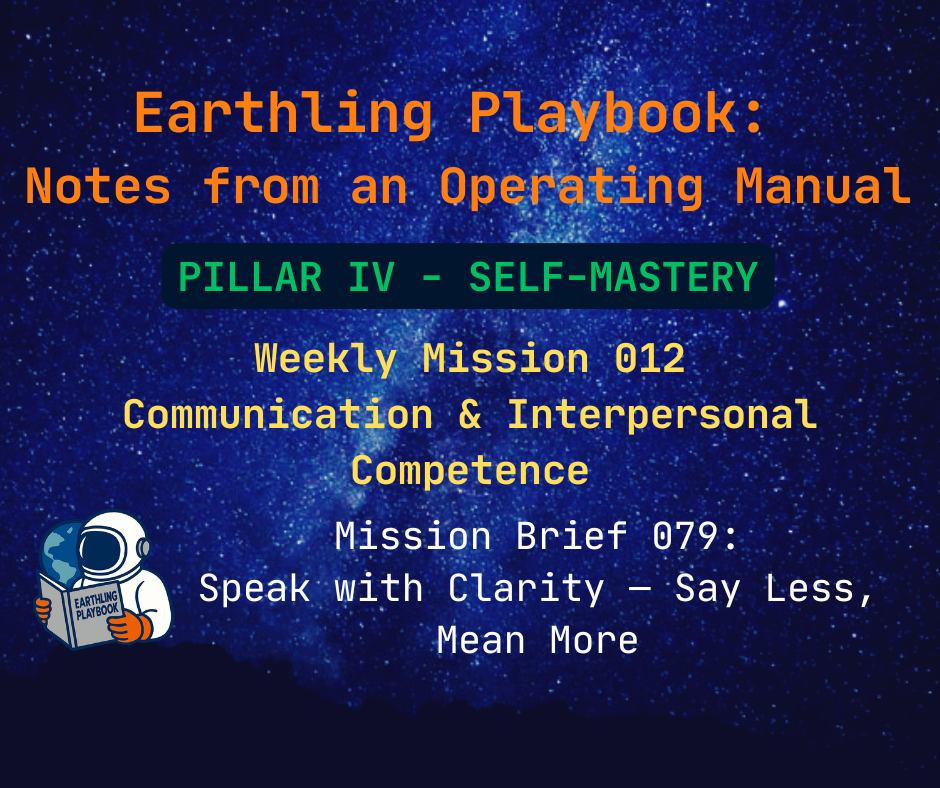
Mission Brief 079: Speak with Clarity — Say Less, Mean More
Stop wasting words. Clarity is precision, not volume.
Most communication problems come from structure—not from lack of intelligence.
When your message has no architecture, your ideas scatter, your listener works harder, and your impact shrinks.
Two simple frameworks fix this instantly:
The PREP Method (Point, Reason, Example, Point)
- Point: We should switch our primary database to the cloud.
- Reason: It cuts hosting costs by 40% and improves latency.
- Example: Competitor X increased performance by 20% after switching.
- Point: Moving to the cloud is the most cost-effective decision.
Point–Because–So Method
- Point: I need your approval on the marketing budget increase.
- Because: Social ads are converting 10% higher than usual.
- So: Approving now lets us maximize ROI before quarter-end.
Everyday Example:
- Point: Let’s meet at 2 PM.
- Because: The café is quiet then.
- So: We’ll have fewer distractions.
Insight:
Clarity doesn’t come from saying more—it comes from structuring what matters and cutting what doesn’t. Tailor every message to the listener’s knowledge level. Avoid jargon unless you’re speaking to people fluent in it.
Why It Matters
Clear communication saves time, reduces friction, and makes your ideas unforgettable.
It boosts your credibility instantly—at work, at home, and in every relationship. The clearer you are, the more influence you carry.
What It Isn’t (Common Misconceptions)
- Clarity isn’t dumbing things down. It’s making ideas accessible.
- Clarity isn’t brevity alone. It’s organized brevity.
- Clarity isn’t “perfect wording.” It’s prioritizing what matters, then deleting the rest.
Unclear communication is a hidden tax — on time, trust, and opportunities.
Did You Know?
Listeners form a “credibility impression” within 7–12 seconds, and attention often drops after 8 seconds. Your first sentence is your most valuable real estate. Use it wisely.
Field Notes
In college, I struggled in creative writing but excelled in technical writing. I loved the challenge of conveying an idea in as few words as possible. That class taught me a lesson I never forgot: clarity isn’t about more words, it’s about removing the unnecessary ones.
Your Mission
Before any high-stakes communication—email, presentation, disagreement, decision—
- Reduce your main message to one sentence.
- Structure the rest using PREP.
Your mission: Make your first sentence your message. Everything else supports it.
“The most valuable of all talents is that of never using two words when one will do.” — Thomas Jefferson
Ask Yourself
- Choose one topic you often over-explain. Rewrite it using Point–Because–So.
- If someone only remembered your first sentence, would they understand your true purpose?
- Where can you cut your words by 20% without losing any meaning?