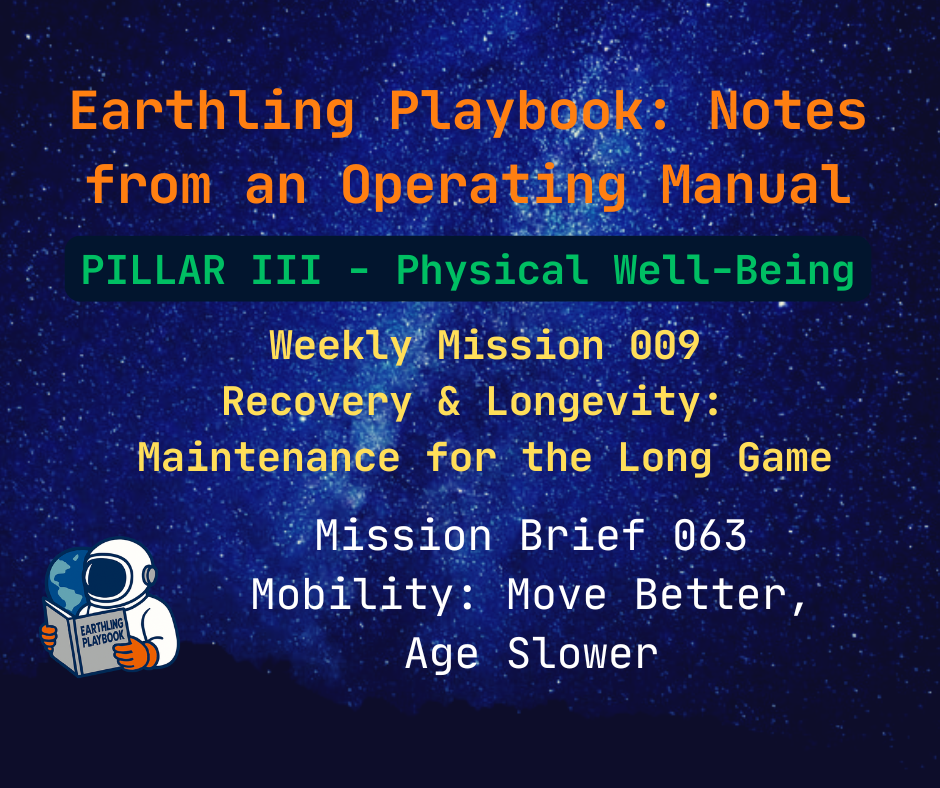
Mission Brief 063 — Mobility: Move Better, Age Slower
You don’t stop moving because you get old. You get old because you stop moving.
Strength matters, but mobility gives you access to it. When joints stiffen, range of motion shrinks, posture changes, and injury risk climbs. Just a few minutes of daily mobility work keeps tissues pliable, improves circulation, and helps movement stay smooth and efficient.
It’s one of the highest-ROI longevity habits: minimal time, zero equipment, lifelong payoff.
Why It Matters
When mobility declines, everyday life gets harder: walking, bending, reaching, lifting, getting up from the floor. That’s how independence slowly slips away.
People with better hip and ankle mobility in midlife move better later in life, with lower fall risk, faster recovery, and less chronic pain. In short: mobility is freedom in motion.
Did You Know?
A daily 5-minute mobility routine has been shown to improve flexibility, balance, and joint function — even in people who don’t do formal exercise.
Field Notes
I’ve always been active—field hockey, track, biking, hiking, backpacking. Even with that foundation, mobility disappears faster than you’d think when you stop tending to it.
It’s not about being “fit.” It’s about how easily you can move through your day. When I skip mobility work, I notice it in the small things: crouching to tie my boots, stepping over a log, twisting to grab something behind me.
Mobility makes strength useful. It’s the difference between effort and ease.
Your Mission
Complete a 5-minute mobility circuit today:
- Shoulder rolls
- Neck rotations
- Hip circles
- Ankle mobility
- Deep squat hold or toe-touch hold (30 seconds)
Pick any time — morning, lunch break, or before bed.
Consistency beats intensity.
“The body will become better at whatever you do—or don’t do. You don’t move? It will make you better at not moving.” — Ido Portal
Ask Yourself
Where do you feel tight or restricted? What would your day feel like with more ease, reach, and fluid movement?
Training Safety Advisory
Mobility work should never be painful. Move gently, breathe, and don’t push into sharp discomfort. The goal is smooth, controlled motion — not forcing range of motion.