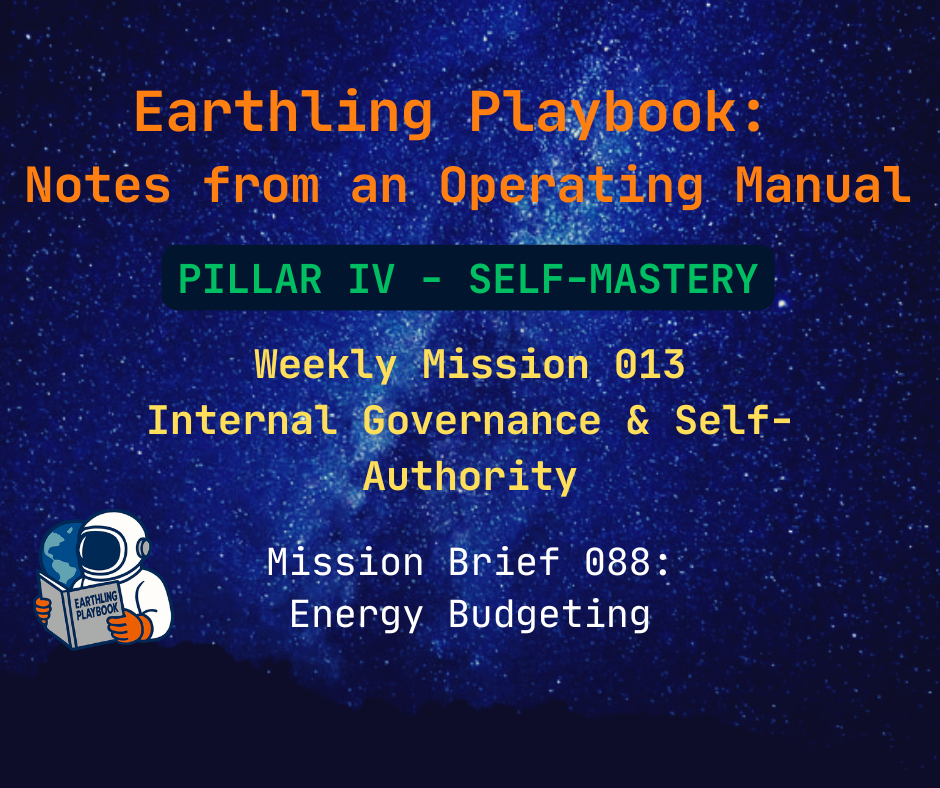
Mission Brief 088: Energy Budgeting
Mission Focus: Allocate energy intentionally instead of reacting to demands.
Energy leaks silently. Today, we plug the drain.
Today’s Mission
Energy budgeting treats your attention and effort as finite, valuable resources. This isn’t about cramming more into your day, it’s about preventing accidental depletion through defaults, interruptions, and unexamined obligations.
By prioritizing your Big Rocks first, the few high-impact priorities that require your best energy, you ensure your focus goes where it matters most. Think of yourself as the CEO of your personal energy reserves: deciding what gets funded, what gets paused, and what gets cut entirely.
Why It Matters
Burnout rarely comes from effort alone. More often, it comes from untracked energy spending, the thousands of small, unconscious drains that leave you depleted before the day’s real work even begins.
Energy budgeting restores self-authority by shifting you from reactive consumption to intentional allocation.
Common Misconceptions (What This Isn’t)
- Not productivity hacking (we’re not chasing speed or output).
- Not time management (time is fixed; energy is not).
- Not optimization culture (this is about preservation, not maximum load).
Did You Know?
Decision fatigue—the decline in your ability to make good choices—spikes when energy is spent reactively on trivial, low-value tasks before meaningful work begins.
Field Notes
I’ve started paying attention to the subtle ways my energy gets spent without actually moving life forward. This is where the Big Rocks analogy really clicked for me: if I fill my mental capacity with “sand” first, small, low-value tasks, there’s no room left for the Big Rocks that require real focus and effort. (Shout-out to a former boss who introduced me to that framework, it stuck.)
One of my most insidious drains is productive procrastination. I’ll clean, organize email, or knock out easy tasks instead of starting the work that actually matters. It feels responsible. It feels productive. But it’s really an energy leak disguised as progress.
Here are three common drain types I’ve learned to watch for:
| Drain Type | Example |
| Productive Procrastination | Cleaning or organizing files instead of starting a Big Rock project |
| Digital Vampires | Endless scrolling, news spirals, or non-urgent notifications |
| Relational Defaults | Saying “yes” out of habit to non-urgent requests that steal prime energy |
Self-Authority Principle:
Just because something feels necessary or productive doesn’t mean it deserves your best energy. If it delays your Big Rocks, it’s an energy drain—no matter how reasonable it looks.
Your Mission
Identify: Using the examples above, spot your most frequent energy drain.
Act: Block it—or severely limit it—for the next seven days.
No perfection required. Awareness plus one intentional boundary is enough.
“You can do anything, but not everything.” – David Allen, Getting Things Done
Ask Yourself
Where is my energy going by default—and who decided that?