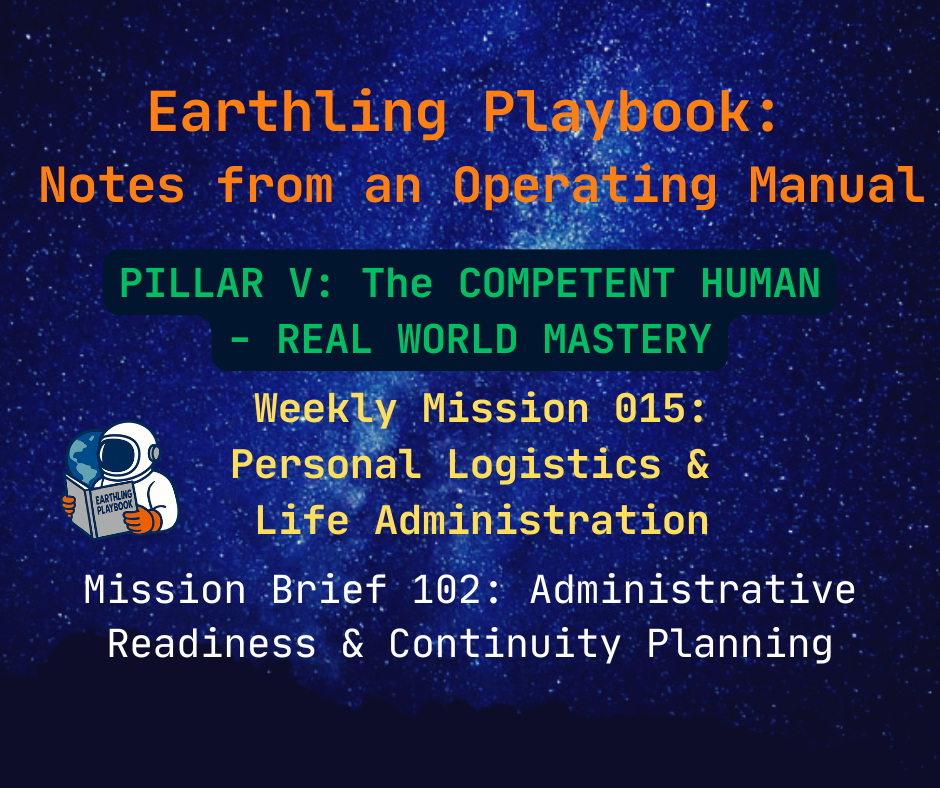
Mission Brief 102: Administrative Readiness & Continuity Planning
Mission Focus: Know what you have, what you’re covered for, and where it lives.
This mission is about administrative continuity—ensuring life keeps running smoothly for you (or those who care about you) even if you’re temporarily unavailable or a crisis strikes.
Today’s Mission
If your house burned down or you were hospitalized tomorrow, could you rebuild your life or manage your affairs within 24 hours?
Medical records, insurance policies, and benefits details are often scattered or forgotten until the exact moment they’re urgently needed. Today, you’ll build the foundation for administrative continuity by applying the systems you’ve already created.
This mission builds directly on:
- Mission Brief 099: Personal Records & Paper Flow
- Mission Brief 100: Digital Hygiene & Access Control
- Mission Brief 101: Calendar Competence — Your Life’s Command Center
Now, you’re applying those tools to your most critical life systems.
1. Centralize Your Vital Documents
Identify, verify, and consolidate the location of your “Big Three”:
- Identity documents (ID, passport)
- Insurance policies (health, auto, home, life)
- Medical cards and key health information
Scan physical documents using a high-quality scanner app (e.g., Adobe Scan) and store them as encrypted PDFs in a secure cloud folder or master password manager.
You’re not aiming for perfection—just reliability.
2. Map Access & Continuity
Document:
- Where things live
- How they’re accessed
- Who should know
- What should happen first in an emergency
This includes locating (not creating) any existing:
- Power of Attorney
- Healthcare Proxy
- Will or estate documents
You are not drafting legal documents today. You are ensuring clarity and access.
Make one small improvement today that makes tomorrow easier.
Why It Matters
- Clarity Reduces Panic: Logistics shouldn’t be a barrier to recovery. Accessible information is a real-world superpower.
- System Maintenance Prevents Crises: Up-to-date admin systems quietly reduce emergencies.
- A Gift to Others: If you’re incapacitated, someone else will need to step in. Giving them a roadmap is an act of care, not morbidity.
- Calm Over Drama: The cost of preparation is small compared to the cost of avoidable chaos.
Common Misconceptions (What This Isn’t)
- “I’ll look it up when I need it.”
→ That’s usually when access fails. - “This is morbid or paranoid.”
→ It’s baseline adult risk management. - “I need to do everything.”
→ No. Better prepared beats perfectly prepared.
Did You Know?
Roughly 25% of people lose access to digital accounts at some point due to missing recovery or legacy plans. Studies also show that preparedness lowers stress hormones and increases perceived control during chaotic events.
Field Notes
I’ve experienced enough real-world disruption to know that preparation matters, especially when access, distance, or timing work against you.
In some places, emergency response is not guaranteed or immediate. Single-route access, long distances, and geographic constraints can mean help is delayed or unavailable during fast-moving events. That reality changes how you plan.
I’ve seen how quickly logistics become friction when systems aren’t ready, and how calm everything becomes when they are.
None of this is about fear or worst-case obsession. It’s about respecting constraints and planning accordingly.
Future-you competence is built by present-you choices made before anything is urgent.
Your Mission
Core Actions
- Gather your policies and cards
- Record key details (coverage, deductibles, renewal dates)
- Store everything in one secure, accessible location
- Create a simple emergency info sheet
- Identify one trusted contact who knows where things live
Quick Wins
- Scan your primary ID and one utility bill
- Schedule one health-related and one logistics-related task
- Prepare one thing today that makes tomorrow easier
Optional Mini-Tasks (Choose One)
- The Life Snapshot: Create a one-page “Critical Info” document
- The Encryption Step: Securely store scanned documents
- The Tomorrow-Ready Task: Prep a meal, pack a go-bag, or stage tools
- The Trusted Contact Step: Clearly tell someone where instructions live
“Expect the best, plan for the worst, and prepare to be surprised.”
— Denis Waitley
Ask Yourself
- Could someone find my insurance or medical details today?
- Who could manage things if I couldn’t?
- What would Future Me thank me for next month?
- Am I choosing the middle ground between neglect and over-prepping?
This mission is for educational and organizational purposes only. It does not replace legal, medical, or financial advice. Consult qualified professionals for personalized guidance.